
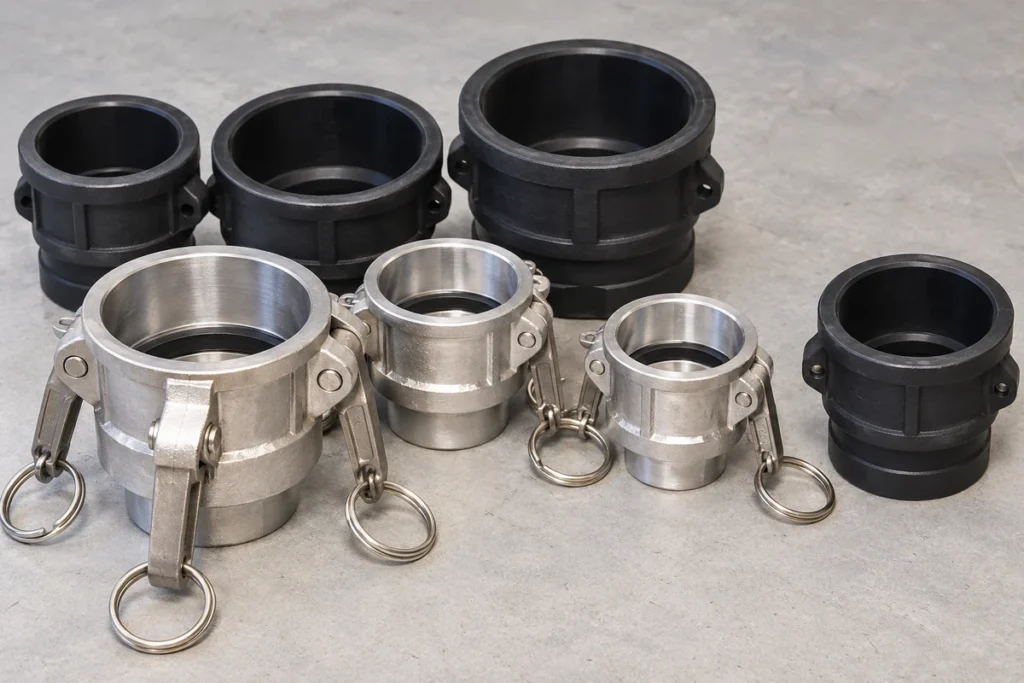
Camlock couplings are a familiar sight wherever hoses need to be connected and disconnected regularly. Also called cam-and-groove couplings, they provide a convenient connection for suitable liquid and bulk-transfer applications.
Our Facebook product feature introduced camlocks available through HACI, including polypropylene and aluminium options. When you contact us about a replacement, identifying the material and nominal size is a useful start. The next step is to check the complete connection and its intended use.
Illustrative image; product details may vary.
Look at both sides of the connection
A camlock connection uses an adaptor and a coupler with cam arms. The arms engage with the adaptor’s groove, bringing it against the seal inside the coupler.
The other end of the fitting matters too. You may need a hose connection or a particular threaded connection. Send photographs that show both ends, along with any markings, rather than a close-up of only the camlock face.
If you need to connect to equipment you already own, include that connection in the enquiry. This is especially useful when an old fitting has no readable identification.
Match the material and seal to the duty
Different body and gasket materials suit different applications. A coupling’s suitability depends on what passes through it, its operating temperature and its pressure requirements. A seal should not be selected by colour alone: manufacturers’ identification systems can differ.
Manufacturer pressure ratings also have stated conditions. For example, Dixon specifies mating components, a particular seal and an ambient temperature for its published polypropylene coupling rating. A headline pressure figure is therefore not a complete selection guide.
Standard cam-and-groove couplings should not be used for compressed air, other compressed gases or steam. Ask about the appropriate connection for those services.
Make your enquiry easier to resolve
When requesting a camlock coupling, tell us:
- What you are transferring.
- The required size and the connection at each end.
- The existing coupling material, if known.
- The working pressure and temperature.
- Whether you need one replacement fitting or a complete hose assembly.
There is no need to identify everything unaided. A clear description and a few useful photographs give our team a better starting point than ordering by appearance alone.
Contact HACI with your coupling requirements. We can help identify the information needed and check the available options for your application.
Related reading: Slurry hoses: choosing the right hose for your application.
This expanded website article is based on an original Facebook post published 18 June 2025; the website article was published 28 September 2026.